
Walmart is taking direct control of its beef supply chain with the opening of its first case-ready processing facility in Olathe, Kansas. The plant packages beef on site and ships finished case-ready products directly to Walmart distribution centers across Missouri, Arkansas, Iowa, Nebraska, Colorado, Montana, Wyoming, North Dakota, Oklahoma, Minnesota, and Wisconsin. By reducing intermediaries, transportation touchpoints, and third-party processing dependencies, the retailer is improving cost control, throughput, and supply chain predictability.
The investment reflects a broader shift across the protein sector, where flexibility, visibility, and vertical integration are becoming competitive differentiators. As processors and retailers contend with labor volatility, capacity constraints, and margin pressure, owning more of the value chain is emerging as a strategic lever to stabilize costs and improve fulfillment performance. For Walmart, bringing case-ready beef processing in-house is designed to build resiliency while increasing transparency from slaughter to shelf.
“It’s important to build more resiliency and capacity in the industry,” a Walmart spokesperson said in an email statement to Investigate Midwest. “Opening a case-ready facility fully owned and operated by Walmart allows us greater control over the products entering our stores so we can continue to bring the highest quality offerings possible.”
Learn More: Walmart’s case-ready facility improves efficiency, transparency, and long-term scalability.
Supply Chain Transparency
Don Olsen, VP Design Operations, ESI Group, explains that more owners want direct control over the products they bring to market, particularly regarding quality and shifts in market demand. He says: “This Walmart facility provides the owner with the ability to adjust products to consumer demand quickly while maintaining better control over product quality from the initial cut through the packaged product.”
The facility supports Walmart’s commitment to a transparent, traceable supply chain, from locally sourced beef through packaging and distribution. By owning the beef cutting and packaging process, Walmart reduces reliance on third-party processors prone to capacity and pricing fluctuations. Direct control over this step improves predictability, resiliency, and operating continuity in large-scale protein processing, says Olsen.
Automation Drives Cost Savings
ESI, which specializes in designing food processing facilities, was involved in early planning and provided full architectural and engineering building design services. The ESI team ensured seamless integration between building systems and specialized meat processing equipment while ensuring the infrastructure would be capable of supporting future processing lines and expansion.
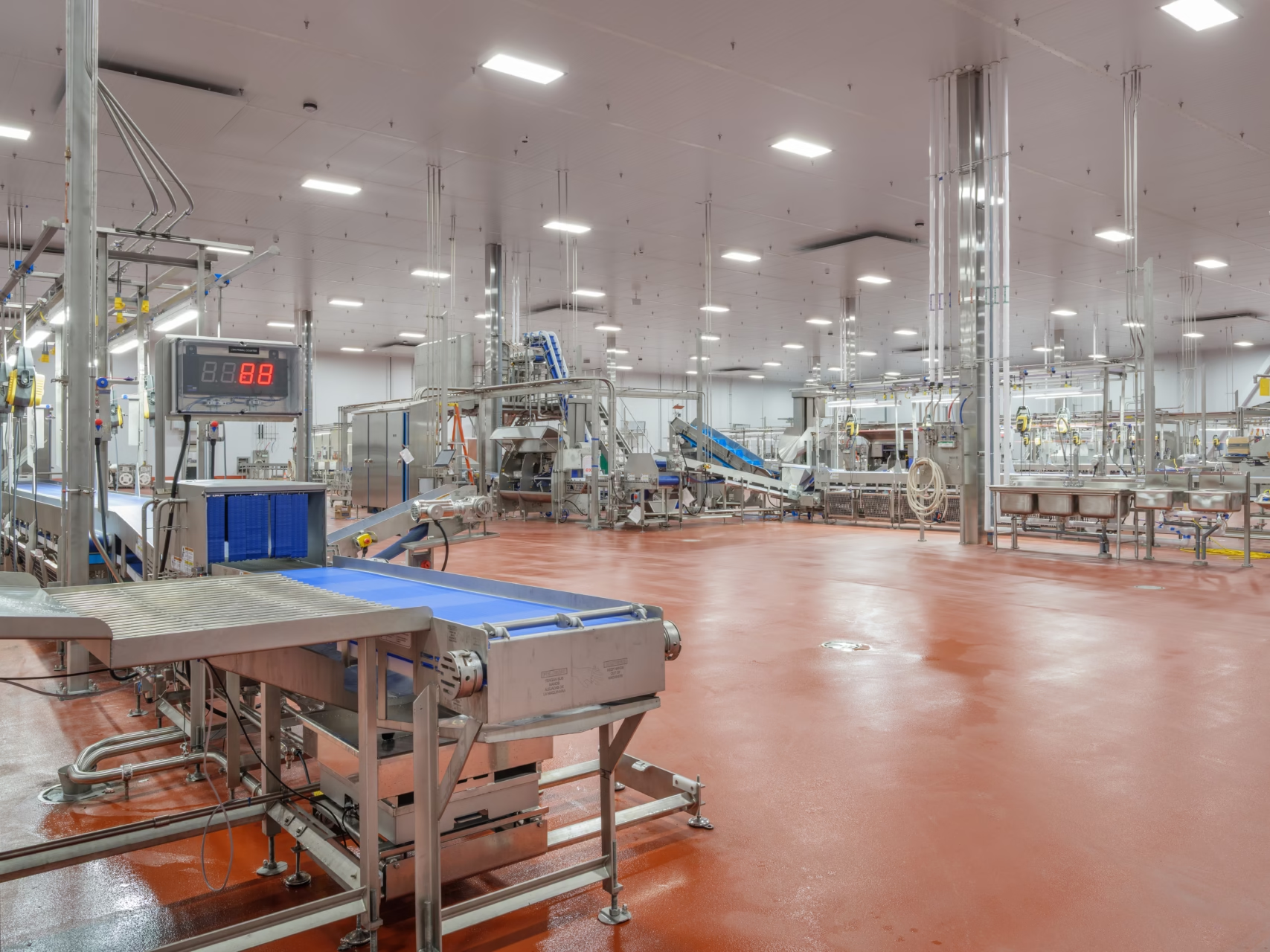
Working in partnership with the general contractor, McCownGordon Construction, the project team delivered a highly automated processing environment designed to minimize manual handling and improve line efficiency. Automated de-palletizing and unboxing systems reduce labor hours while limiting product damage and ergonomic strain. Conveyance systems integrate directly with portioning and packaging lines to create continuous product flow and reduce bottlenecks. Vision-guided systems and precision water-jet cutting improve trim accuracy and yield, ensuring consistent fat removal while minimizing giveaway. By reducing variability and labor dependency, the facility achieves higher throughput with more predictable output. “This added efficiency allows the owner to pass along cost savings to their customers,” says Olsen.
TCO for Today and Tomorrow
A total cost of ownership (TCO) approach guided the design and engineering process, considering energy efficiency, maintenance, and lifecycle performance. Early engagement aligned the team to reduce risk and make key financial and schedule decisions. Multiple refrigeration strategies were analyzed using comparison matrices, providing Walmart with clear, data-driven insight. Ultimately, a central ammonia refrigeration system was chosen for its efficiency, scalability, and long-term reliability.
The facility supports future processing lines, increased capacity, and higher automation. Building systems and utilities were sized for evolving production demands, allowing Walmart to adapt without major disruptions or costly retrofits, ensuring operational resilience.

“A TCO approach allows the owner to evaluate decisions beyond initial capital cost,” says Olsen. “Factoring in energy use, maintenance, scalability, and lifecycle performance provides the insight needed for disciplined, long-term decisions that protect margins and operational flexibility.”
Great Design Requires Collaboration
Walmart’s case-ready processing facility reflects a strategic evolution in meat supply chain design. Delivered through a collaborative design-build approach, the project demonstrates how integrated food processing facility design can improve operational efficiency, supply chain control, and long-term scalability.
“Good design comes from listening to the owner to understand what they need to make their business succeed and design accordingly,” says Olsen. “Great design comes collaboratively with the owner, process engineer, equipment suppliers, and contractors from the beginning to develop the best design taking into account not only the owner’s design needs but also understanding real-time cost implications, schedule implications, equipment options, etc. This in-depth collaboration keeps the design and construction process on track and limits changes that could affect budget and schedule.”
Quick Facts
1. De-palletizer speed is typically designed to run 20% faster than product input speed
2. A TCO approach to design can generate up to 30% in cost savings
3. The US case-ready meat market could reach $20.3 billion by 2033

Join our eNewsletter
Get industry trends and insights for climate-controlled facility design and construction quarterly.